

Dr. Avi M. Mandell
Observations of Exo-Planet Atmospheres
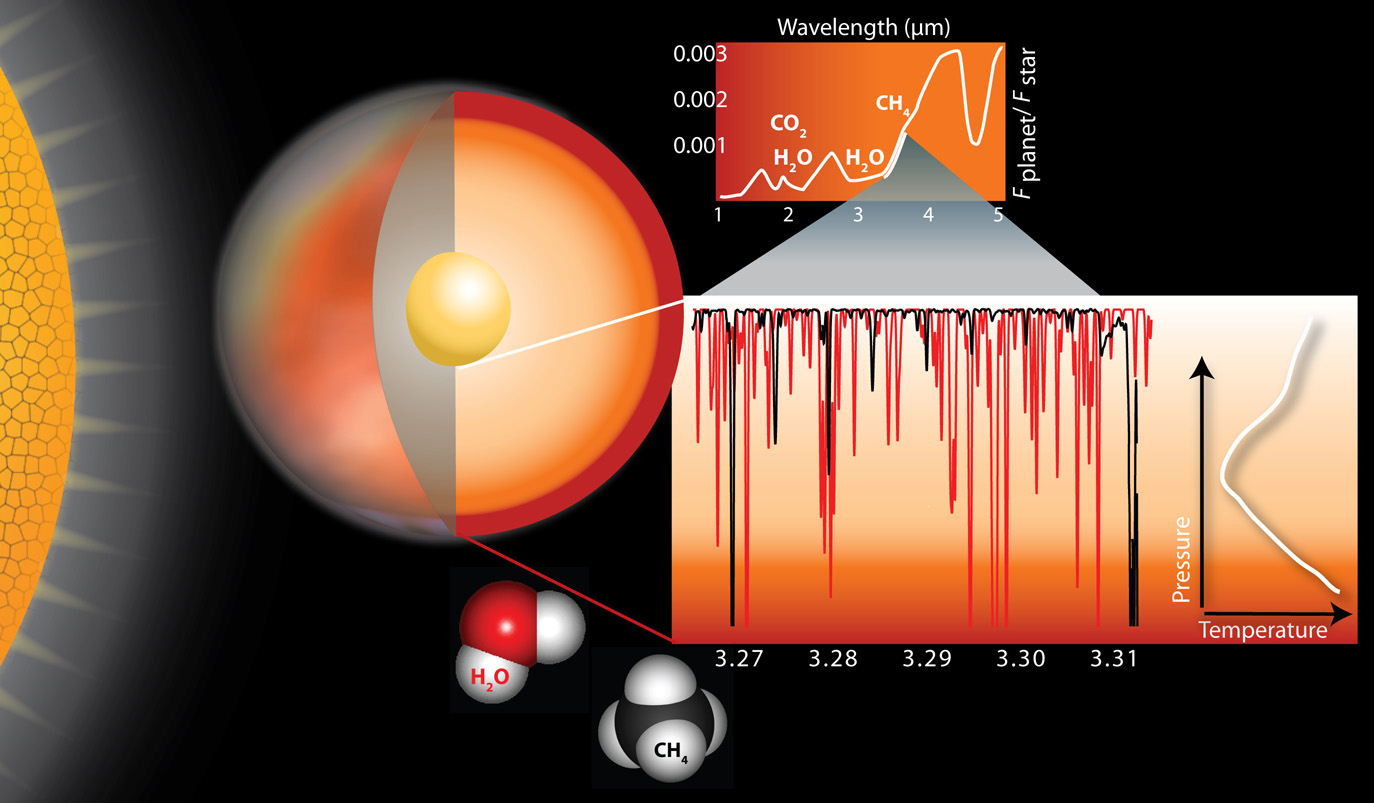
Spectroscopic or multi-band observations of transiting extra-solar planets in the NIR can provide information on the thermal and chemical structure of the atmospheres of these planets by allowing us to observe the emission from within molecular bands (which probe the upper atmosphere) as well as outside of molecular bands (which probe deeper into the atmosphere), and are therefore sensitive to both changes in temperature structure and changes in chemical composition. Precise observations of the thermal radiation from these planets' atmospheres can firmly identify the planets with temperature inversions and unusual chemical compositions. Furthermore, comparison of the incident flux on a planet with the emergent day-side flux constrains the degree of heat transport to the nightside and thereby informs our understanding of the planet's atmospheric dynamics.
In my research I tackle this problem using several different strategies that leverage either the high information content of high-resolution infrared spectra or the ability to obtain extremely precise lower resolution data with photometry or low-resolution spectroscopy. One project involves extending our NIR data reduction techniques used for circumstellar disk observations to conduct a search for individual molecular emission features from the atmospheres of known extra-solar "Hot Jupiter" planets using ground-based high- resolution spectroscopy with the NIRSPEC instrument on the Keck Telescope. Additionally, I am utilizing a number of lower-resolution instruments (including the Hubble Space Telescope) to probe broader molecular features in the NIR at very high precision.
Non-detection of L-band Line Emission from the Exoplanet HD189733b (2011)
Using existing observations with NIRSPEC, we attempted to confirm the bright emission signal from the exoplanet HD 189733b at 3 microns announced by Swain et al. (2010) based on observations with the IRTF. Their observations were a much lower spectral resolution, and they claimed that the most likely explanation was emission from methane in non-local thermodynamic equilibrium (non-LTE). Non-LTE emission from gas in an exoplanet atmosphere will not be significantly broadened by collisions, so the measured emission intensity per resolution element must be substantially brighter when observed at high spectral resolving power. We observed the planet before, during, and after a secondary eclipse event at high resolving power using the NIRSPEC spectrometer on the Keck II telescope. Our spectra covered a spectral window near the peak found by Swain et al., and we compared emission cases that could account for the magnitude and wavelength dependence of the Swain et al. result with our final spectral residuals. To model the expected line emission, we use a general non-equilibrium formulation to synthesize emission features from all plausible molecules that emit in this spectral region. In every case, we detect no line emission to a high degree of confidence. After considering possible explanations for the Swain et al. results and the disparity with our own data, we concluded that an astrophysical source for the putative non-LTE emission is unlikely. We note that the wavelength dependence of the signal seen by Swain et al. closely matches the 2nu2 band of water vapor at 300 K, and we suggest that an imperfect correction for telluric water is the source of the feature claimed by Swain et al.
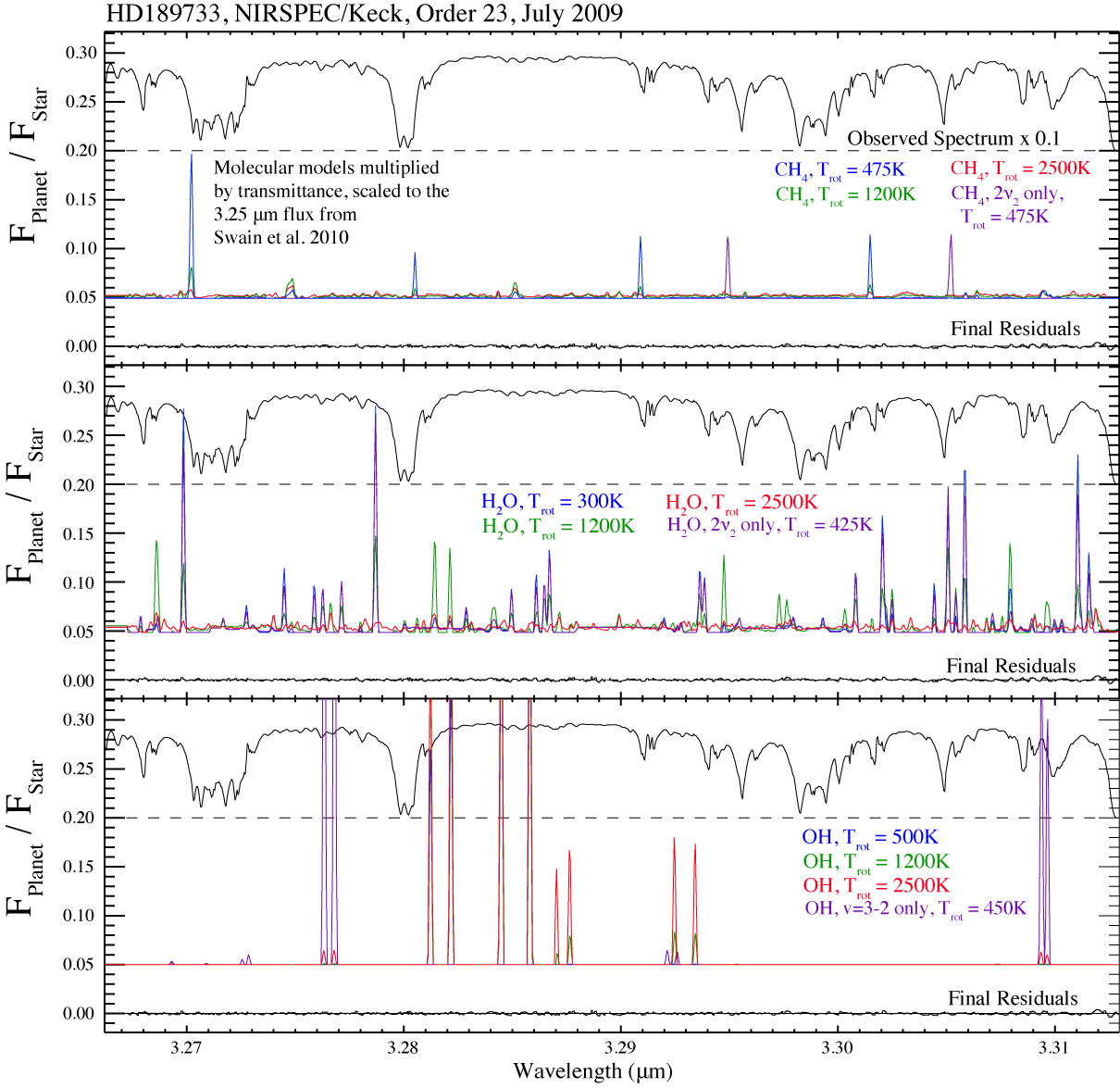
Mandell et al. 2011, Figure 4: Results from our data reduction, with candidate molecular models using the CH4@Titan and HITEMP2010 line lists overplotted. The upper black trace is the original data, and the bottom black trace are our residuals after removing telluric and stellar features, shifting the data to the correct radial velocity and combining it, and then removing large-scale gradients in the continuum with a high-pass filter (as described in Section 2). Models for CH4 (top) and H2O (bottom) with different excitation temperatures are plotted above. We detect no emission at any of the expected positions, with upper limits more than 10 times below the total intensity of the expected emission for each model.
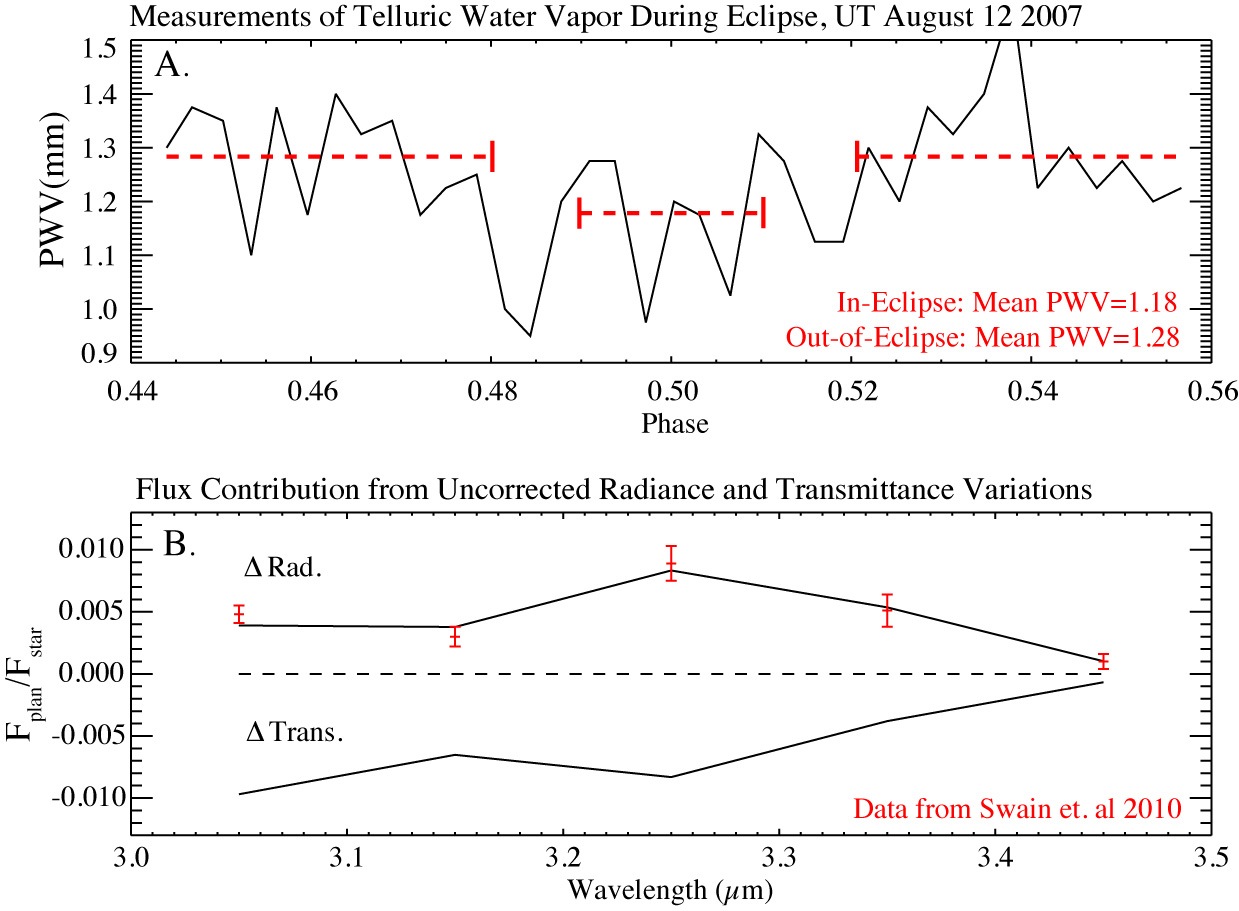
Mandell et al. 2011, Figure 5: Plot of the effects of changes in telluric water absorption during the observing night analyzed by Swain et al. (2010, UT 2007 August 12). Telluric water vapor affects both the transmittance (how much star light reaches the detector) and the sky radiance (how much background thermal emission arrives from the atmosphere). (a) Measurements of PWV using data from the tipping radiometer at the Caltech Submillimeter Observatory on Mauna Kea (black), with the mean in-eclipse and out-of-eclipse values overplotted (red). (b) We calculated the changes in transmittance (delta-Trans) and radiance (delta-Rad) for the measured change in water vapor, and compared them to the results from Swain et al. (2010). While we cannot identify with certainty the cause of the differences between our data and the results from Swain et al. (2010), the similarity between the effects of changes in sky radiance and the Swain et al. results is consistent with inaccurate removal of variable telluric features.
Relevant Publications
Mandell, A. M., Deming, L. Drake, Blake, G. A., Knutson, H. A., Mumma, M. J., Villanueva, G. L., & Salyk, C. “Non-Detection of L-band Line Emission from the Exo-Planet HD189733b”. 2011, ApJ, 728, 18

Contact Information
NASA GSFC
Code 693.0
Greenbelt, MD 20771
Email: Avi.Mandell (at) nasa.gov