

Dr. Avi M. Mandell
Simulations of Planet Formation
The discovery of the first extra-solar planets more than a decade ago both proved the existence of planets outside our own system and demonstrated that our theories of planet formation were woefully incomplete. The first extra-solar giant planets discovered orbit within 0.05 AU of their parent star, and as long-duration studies increase their sensitivity to long-period planets at large distances several trends have become apparent: there remains a significant accumulation of planets in circular orbits at distances < 0.25 AU (colloquiually named "hot Jupiters"), and a large majority of planets at larger distances show evidence of planet-planet scattering. It is now clear that the forces that drive the final stages of planet formation are much more complex than previously thought. In order to develop an accurate picture of the potential for the formation of habitable planets in these systems, we must combine both observations and computational modeling to better understand the processes that govern the formation and transport of material during different stages of planet formation.My work focuses on modeling the formation of terrestrial planets focuses on the accretion of Moon-sized bodies during the last stages of the formation of rocky planets, both in our own Solar System and in extrasolar planetary systems.
Formation of Earth-like Planets During and After Giant Planet Migration (2004-2007)
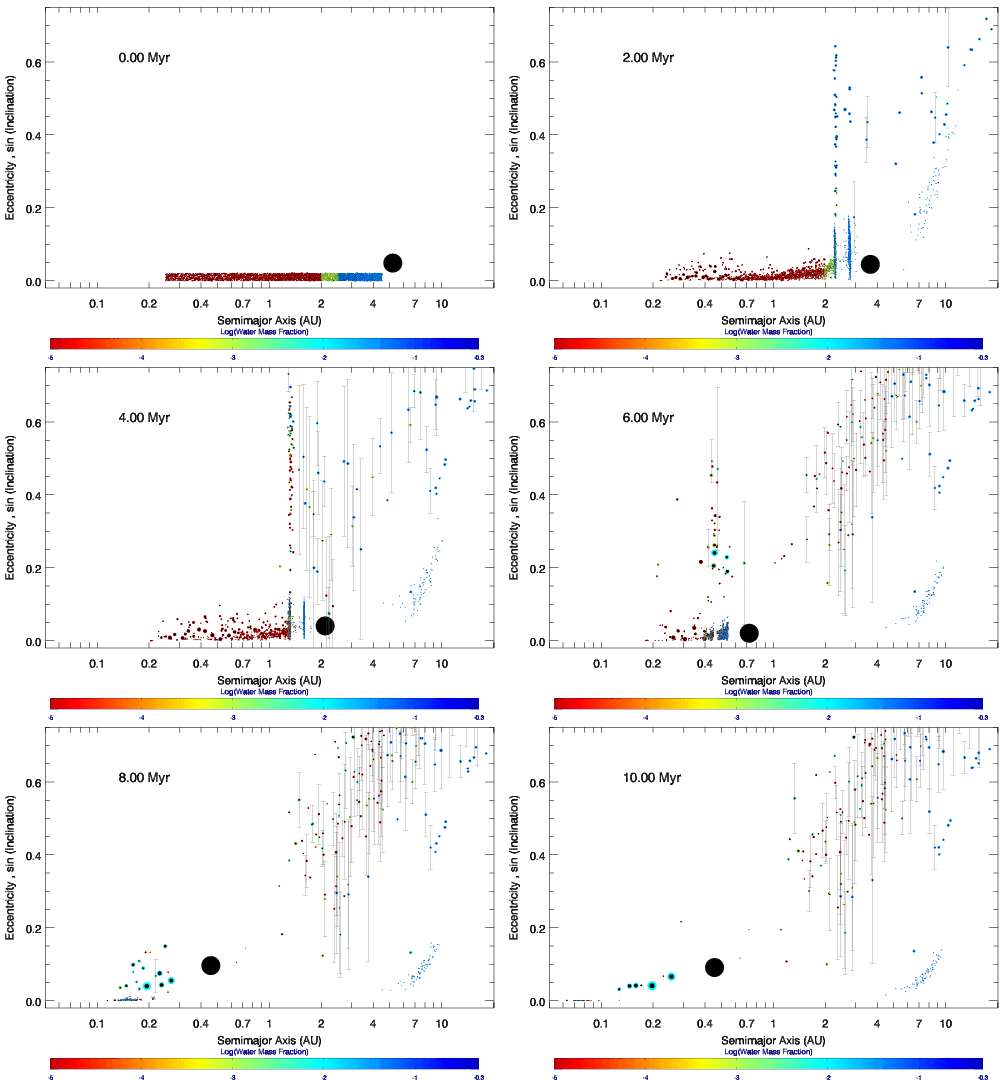
My initial work involved N-body simulations investigating the evolution of a protoplanetary disk during and after the migration of a Hot Jupiter through the inner system, in collaboration with Dr. Sean Raymond and Dr. Steinn Sigurdsson. Current theory suggests that Hot Jupiters were forced to their current location by the draining of the gaseous nebula onto the central star, and early conjecture assumed that no rocky Earth-like planets could form in these systems. Our simulations followed protoplanetary embryos to full terrestrial planet mass over 200 Myr, for several different sets of initial conditions, after migrating a giant planet to a very small radius (0.2 AU). Results of these simulations demonstrate that 65% - 85% of protoplanetary material can survive and grow to Earth-mass bodies, both in the normal terrestrial zone as well as interior to the giant planet (forming analogs to the so-called "Hot Earths" already detected). Planets formed in these simulations are water-rich due to vigorous radial mixing stimulated by the migrating Jupiter and inward migration of water- rich material due to gas drag (see Figure below).
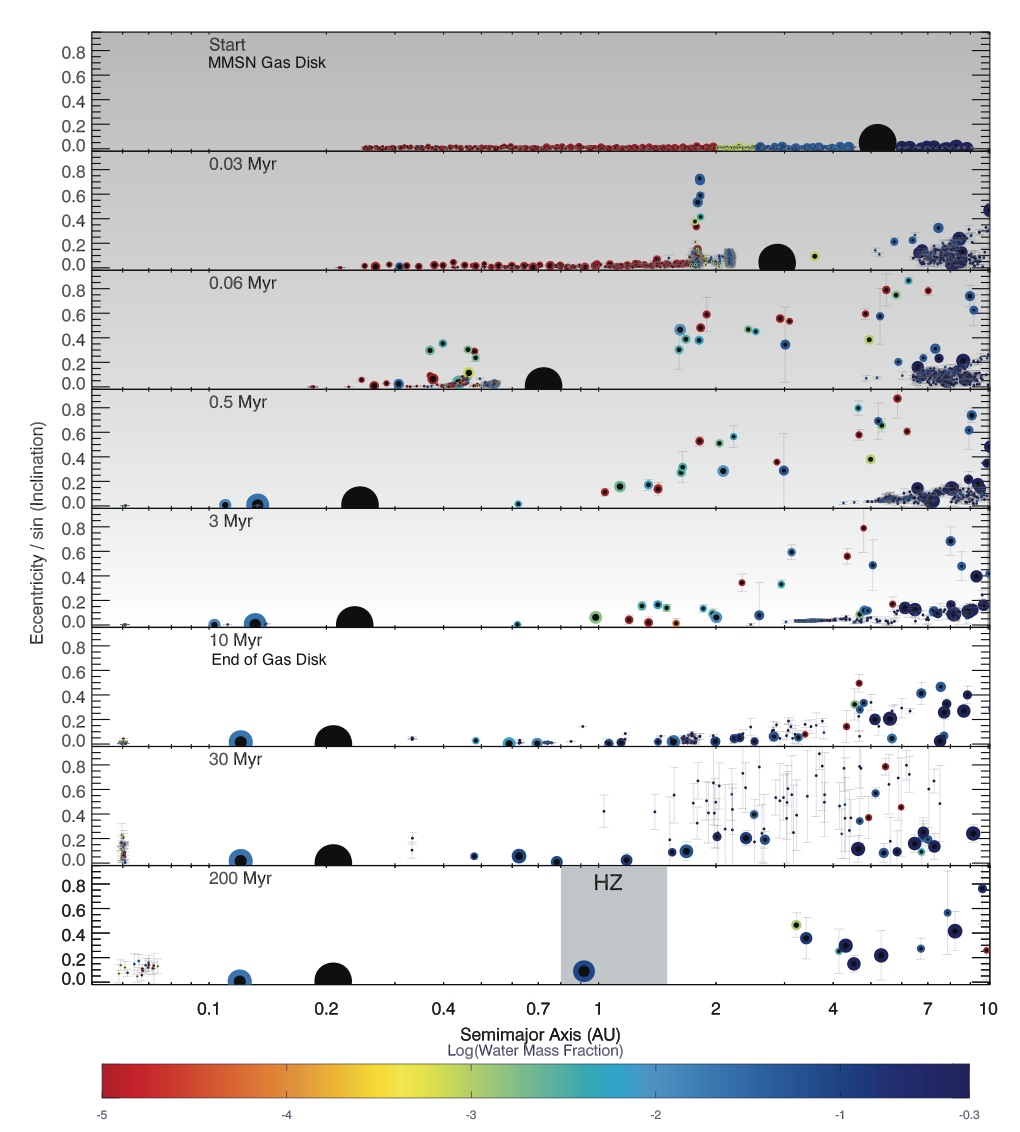
Mandell et al. 2007, Figure 2: Evolution of a Jupiter-mass planet migrating through a protoplanetary disk. Radial distance is plotted on the x-axis in Astronomical Units, with eccentricity on the y-axis. Inclination of the orbit is indicated through error-bars on each point, and and water content is indicated by the color (a reference bar is located below the plot). The size of each point is proportional to M1/3, with the size of the inner black region representing the iron mass fraction. The system forms a 'hot Earth' and a massive terrestrial planet in the Habitable Zone. Water contents are high through radial mixing and migration of planetesimals.
Relevant Publications
Raymond, S. N., Barnes, R., & Mandell, A. M. "Observable consequences of planet formation models in systems with close-in terrestrial planets". 2008, MNRAS, 384, 663.
Mandell, A. M., Raymond, S. N., & Sigurdsson, S. "Formation of Earth-like Planets During and After Giant Planet Migration". 2007, ApJ, 660, 823.
Raymond, S. N. & Mandell, A. M. (co-primary author), & Sigurdsson, S. "Exotic Earths: Forming Habitable Worlds with Giant Planet Migration". 2006, Science, 313, 1413
Mandell, A. M. & Sigurdsson, S. "Survival of Terrestrial Planets in the Habitable Zone in the Presence of Giant Planet Migration". 2003, ApJL, 599, L111.

Contact Information
NASA GSFC
Code 693.0
Greenbelt, MD 20771
Email: Avi.Mandell (at) nasa.gov